Despite what you may be thinking, we have not abandoned our blog. Life has just been very busy- which by our standards is a very good thing (it makes you forget about the heat…kinda)! So, since we last wrote, what have we been up to?
At the end of September we went to Ghana for a week. It was a great vacation and a good break from Benin. Ghana is much more developed than Benin, so we were able to eat sushi and go to a real movie- what a treat! We spent most of the time travelling along the coast visiting historical European forts and slave trade sites- as well as enjoying the beach! (will post more on this later along with some pics)
School started at the beginning of October- and well, that is mainly why you haven’t heard from us (because I am the one that writes the blog posts)! The beginning of the school year is always interesting because it is a demonstration in the lack of efficiency of the Beninese government. So even thought the 1st day of school was set for October 4th, that didn’t mean much. The school administration showed up and started paper work, but teachers and students don’t actually start showing up until about a week later- and classes really start another week after that. So the beginning of this year was even more interesting because a week after the “official” start date, the government announced administration changes. Why they didn’t take the 3 month break to do this so that the new administration could be in place for the new school year, I am not sure. The top 3 people in my school administration were to be sent elsewhere. Even though this was good news (the Director was very dishonest), it meant a huge delay on the already delayed start to the school year. However, Madame Miranna ignored the confusion around her and started teaching. Another week later the government held a mandatory week-long training for all the teachers. Again, why didn’t they take any week in the 3 month break to do this? The new administration arrived at the end of October and it was at this point that teachers began receiving their class schedule. So, most teachers actually started teaching at the beginning of November- a full month later. It is now one week into December and exams are next week. After 1 month of classes (and not even a full month, depending on how often teachers actually show up for work) students are going to be tested.
All in all, I love teaching and am so glad this was my assignment. But, there are many frustrating moments- not just because of the structure of the system, but also because of attidues towards learning? By the time I am get the students in my classes they have already spent 7-8 years in the Beninese school system. This is a system that rewards those that can copy, memorize, and regurgitate. There is absolutely no creative thinking developed in these children. I push my students to try and think outside the box in multiple ways but it is a struggle because students don’t want to be pushed. They simple want the answer so they can memorize it. As long as they can get the passing average on the test, that is all they need. There are no rewards in this system for top students, no honor classes, no scholarships, etc. So, why does it matter if a student has the best grade in the class? There is no push for students to be the best and the brightest. To me this is really sad, because I have a few really talented students and I see them just getting lost in the system.
These are just some of the many problems with the Beninese educational system- I can’t even begin to write about them all. It is so frustrating to watch the inefficiency of the school system because it is just hurting the children- and subsequently the future of Benin. Since we’ve been here, I have concluded that this is the #1 problem in Benin. Granted, I might be a little biased in my view because I see the problems on a day to day basis- whereas an environmental or health volunteer might have a different opinion. However, until the education system is reformed Benin is never going to be able to develop. The lack of creative thinking permeates all levels of society here and this will take a long time to change.
I am only one person and I can’t change the system, but I do my best to be a positive role model for the other teachers to inspire them to change teaching methods and attitudes. I also devote a lot of time and energy to working with students- especially those that excel. On this end, I also hope that I have helped one or two students decide to stay in school, be creative thinkers, and be the best they can be.
Sunday, December 12, 2010

Saturday, October 9, 2010
Good Times in Ghana
We decided to take a trip to Ghana at the end of September to enjoy the last bit of "free time" before Miranna started back to school. While Ghana doesn’t seem that far from Benin, from our house in Lalo- through Togo- and then to Accra, the capital of Ghana, it was about a 7 hour taxi ride- multiple taxis, that is. But, the reward at the end of a long travel day was mojitos and sushi- a big treat for us!
Accra is very developed, probably the most developed city in West Africa, so we took full advantage and pretended we were back in America for a few days. This included a trip to a mall and a real movie theater!After a few days in Accra, we travelled along the coast to visit many of the coastal forts that were used during the slave trade days- mainly by the Portuguese and Dutch. It was really interesting- and also sad- to see this side of history. One the forts was visited by Obama when he was in Ghana. The fort has a place where visiting dignitaries lay reefs as a memorial to those having gone through the slave trade. Aside from some historical tourism, we also spent some time relaxing on the beach in the coastal towns and visiting a national park where we walked across a swinging bridge through the tree canapoy. Ghana really does have a beautiful coastline! Enjoy the pics….

Our beach hut.


Fishing village.

M making me pose while the fishermen bring in their catch.

Animal santuary we visited that protects endangered monkeys, birds and just about any other animal brought in. The owners pay the hunters to not kill trapped animals or young who are orphaned by hunting.

View of Cape Coast from the top of the fort. That's Charlie's Benin Squirrels soccer jersey. Yes the national team is called the Benin Squirrels.
Cape Coast fort.
Accra is very developed, probably the most developed city in West Africa, so we took full advantage and pretended we were back in America for a few days. This included a trip to a mall and a real movie theater!After a few days in Accra, we travelled along the coast to visit many of the coastal forts that were used during the slave trade days- mainly by the Portuguese and Dutch. It was really interesting- and also sad- to see this side of history. One the forts was visited by Obama when he was in Ghana. The fort has a place where visiting dignitaries lay reefs as a memorial to those having gone through the slave trade. Aside from some historical tourism, we also spent some time relaxing on the beach in the coastal towns and visiting a national park where we walked across a swinging bridge through the tree canapoy. Ghana really does have a beautiful coastline! Enjoy the pics….

Our beach hut.


Portuguese Catholic mission that turned into a fort to fend off the Dutch.

Fishing village.

M making me pose while the fishermen bring in their catch.

Animal santuary we visited that protects endangered monkeys, birds and just about any other animal brought in. The owners pay the hunters to not kill trapped animals or young who are orphaned by hunting.

View of Cape Coast from the top of the fort. That's Charlie's Benin Squirrels soccer jersey. Yes the national team is called the Benin Squirrels.

Terrified, we took this picture from the hanging bridge. The suspension system hung some 80 meters above the ground in the giant trees.

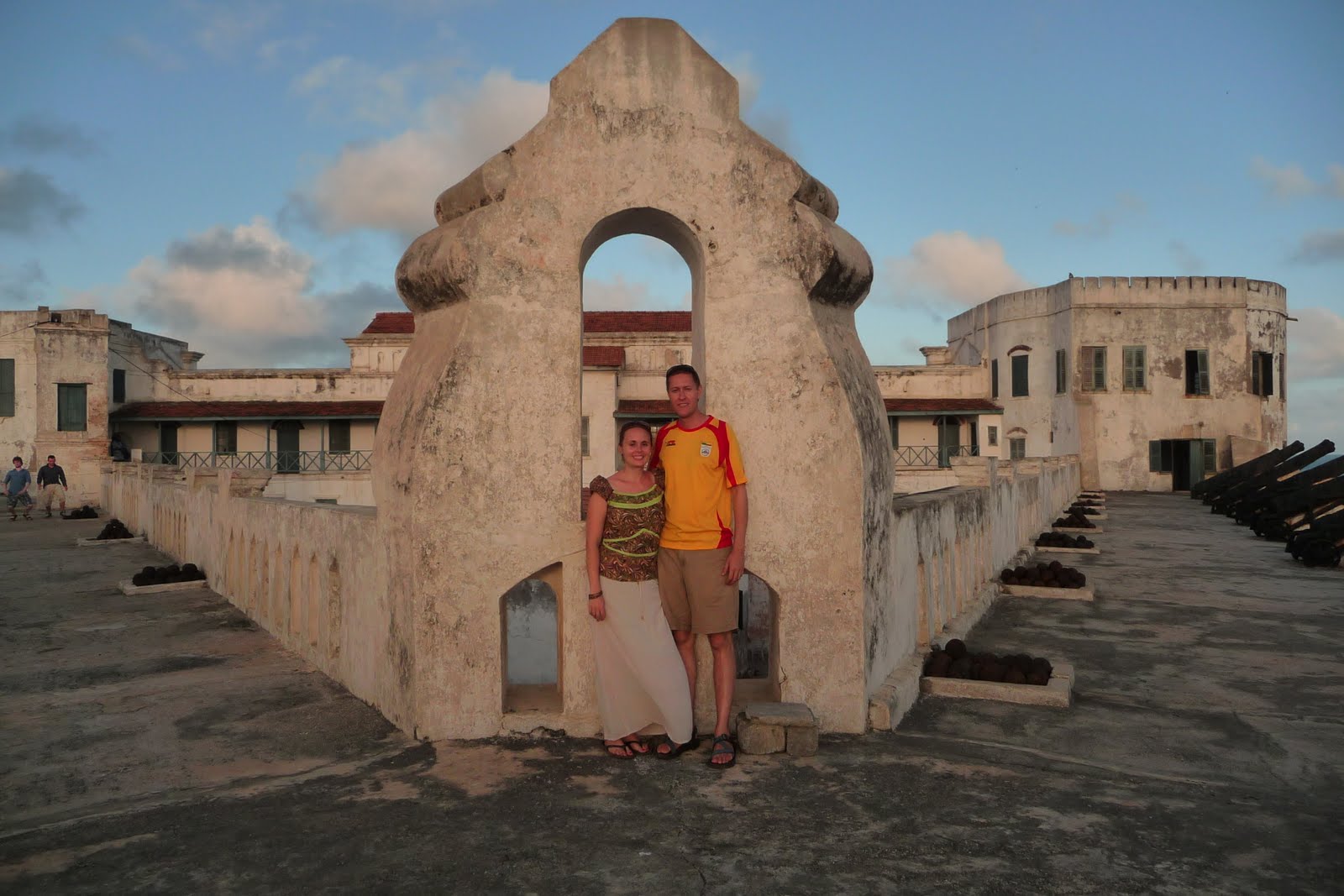
Cape Coast fort.
Friday, September 10, 2010
Believin' in Benin
Benin is a very religious nation. Christianity is the largest religion in the South (there are a lot of Catholics, in particular, in Lalo) and Islam is more prevalent in the North. However, the national and biggest religion of Benin is “Vodoun,” or Voodoo as we spell it. Voodoo is an animistic religion, but its beliefs and gods are usually mixed with other religions. That is to say that if a Beninese is Catholic, they also practice Voodoo as well.
Voodoo in Benin is not the violent religion of bloody-sacrifices and voodoo dolls that we think of, but instead it is about the power of nature and the natural forces in life. It permeates every aspect of life in Benin because they believe that spirits are everywhere and are an integral part of daily happenings in life. It is most easy to relate Voodoo beliefs to the Native Americans’ beliefs that there were spirits in every part of nature and they must be properly cared for, if they are going to care for you in return. For example, this rainy season there was not a lot of rain. The Beninese explained this by saying that the gods must not have been properly thanked after last year’s rainy season. In this case they would do a sacrifice for the gods- typically a chicken or a goat. That being said, this is not an everyday occurrence that we see here.
The Beninese also use voodoo to explain what happens in life that they can’t understand. For example, if a person suddenly dies, it is assumed that they must have done something bad and they were either cursed by someone or a god. Whereas we would contribute a death to a medical condition and then have an autopsy performed, the Beninese assume that they died for a reason. We have seen this on multiple occasions, including with one of Miranna’s students, Ivette, that died in November. It was explained to us (in a very matter of fact manner) that her sister had refused to get married because she wanted to stay in school, so Ivette helped her run away. Her father was upset with her and put “gris-gris” on her. Shortly thereafter Ivette developed a headache and then she died. This story was hard to digest because common sense tells us that people don’t just suddenly die of headaches. Maybe she had already been sick and it was a coincidence that she died when her dad was upset with her- or maybe the Beninese have some rhyme and reason to their beliefs.
“Gris-gris” is a ceremonial process where someone is either partaking in an effort to protect themselves from evil spirits or performing an act to bring harm to someone. An example of the latter is mentioned above. As an example of protecting themselves, people often make a special soap with which to wash themselves. We were privy to watching one of these soap making ceremonies- which was very interesting. The process was as follows: grounding up a lot of leaves, roots, and herbs that all have medicinal powers, mixing in some sodabi (the local alcohol), sacrificing a chicken on top of the soap, and then chanting in the local language. We were told that if you wash yourself with this soap at least once a month, then you are protected from all the evil spirits. We personally declined taking some home, we’re happy with Dove.

The Village Chief adding alcohol to the soap during the ceremony.
Another aspect of voodoo that plays an important role in life here is the strong belief in the afterlife. When someone dies they turn into a spirit- and this is one reason why funerals are such a big event (and why so much money is spent on them). Not only is it necessary to celebrate the life they lived, but it is necessary to welcome the rebirth of their spirit. The two types of “spirits” that we commonly see are pictured below. At some point, before, during or after a funeral service the spirits come out and dance and “speak” to the onlookers. These are really big events in Lalo which involve a lot of drumming, singing, and dancing. The spirits also “chase” the onlookers and it is forbidden that they touch you because you will then die- so you better run fast!

Zangbetos (don't they look like the characters in the book "Where the Wild Things Are"?)

Egunguns (While not the most friendly of fellows, their costumes are really bright and colorful!)
This is just an overview of beliefs here in Benin- as we have experienced them. Voodoo is a complicated and mysterious religion that we will not fully understand even after 2 years. It’s hard to explain the depths to which these beliefs affect everyday life. In addition, religion, whether voodoo or otherwise, has an enormous economic toll. The amount of money that is spent on special clothes, religious items, funerals, and offerings blows our mind. We have been to a few religious services and at each one they take offerings no less than five times throughout the mass. At the end of the service, they then announce how much money was raised for the church that day. However, when there are not too many other distractions in life in a small village, on what else are you going to spend your money and time?

Miranna with our neighbors after Inez, the youngest daughter in the family, was confirmed in the Catholic church. For a ceremony such as this, most everybody in the church will wear outfits made of matching cloth. We had been out of town before the big event, so we were not able to purchase religious fabric featuring the Saint Augustin. We were crushed!
Voodoo in Benin is not the violent religion of bloody-sacrifices and voodoo dolls that we think of, but instead it is about the power of nature and the natural forces in life. It permeates every aspect of life in Benin because they believe that spirits are everywhere and are an integral part of daily happenings in life. It is most easy to relate Voodoo beliefs to the Native Americans’ beliefs that there were spirits in every part of nature and they must be properly cared for, if they are going to care for you in return. For example, this rainy season there was not a lot of rain. The Beninese explained this by saying that the gods must not have been properly thanked after last year’s rainy season. In this case they would do a sacrifice for the gods- typically a chicken or a goat. That being said, this is not an everyday occurrence that we see here.
The Beninese also use voodoo to explain what happens in life that they can’t understand. For example, if a person suddenly dies, it is assumed that they must have done something bad and they were either cursed by someone or a god. Whereas we would contribute a death to a medical condition and then have an autopsy performed, the Beninese assume that they died for a reason. We have seen this on multiple occasions, including with one of Miranna’s students, Ivette, that died in November. It was explained to us (in a very matter of fact manner) that her sister had refused to get married because she wanted to stay in school, so Ivette helped her run away. Her father was upset with her and put “gris-gris” on her. Shortly thereafter Ivette developed a headache and then she died. This story was hard to digest because common sense tells us that people don’t just suddenly die of headaches. Maybe she had already been sick and it was a coincidence that she died when her dad was upset with her- or maybe the Beninese have some rhyme and reason to their beliefs.
“Gris-gris” is a ceremonial process where someone is either partaking in an effort to protect themselves from evil spirits or performing an act to bring harm to someone. An example of the latter is mentioned above. As an example of protecting themselves, people often make a special soap with which to wash themselves. We were privy to watching one of these soap making ceremonies- which was very interesting. The process was as follows: grounding up a lot of leaves, roots, and herbs that all have medicinal powers, mixing in some sodabi (the local alcohol), sacrificing a chicken on top of the soap, and then chanting in the local language. We were told that if you wash yourself with this soap at least once a month, then you are protected from all the evil spirits. We personally declined taking some home, we’re happy with Dove.

The Village Chief adding alcohol to the soap during the ceremony.
Another aspect of voodoo that plays an important role in life here is the strong belief in the afterlife. When someone dies they turn into a spirit- and this is one reason why funerals are such a big event (and why so much money is spent on them). Not only is it necessary to celebrate the life they lived, but it is necessary to welcome the rebirth of their spirit. The two types of “spirits” that we commonly see are pictured below. At some point, before, during or after a funeral service the spirits come out and dance and “speak” to the onlookers. These are really big events in Lalo which involve a lot of drumming, singing, and dancing. The spirits also “chase” the onlookers and it is forbidden that they touch you because you will then die- so you better run fast!

Zangbetos (don't they look like the characters in the book "Where the Wild Things Are"?)

Egunguns (While not the most friendly of fellows, their costumes are really bright and colorful!)
This is just an overview of beliefs here in Benin- as we have experienced them. Voodoo is a complicated and mysterious religion that we will not fully understand even after 2 years. It’s hard to explain the depths to which these beliefs affect everyday life. In addition, religion, whether voodoo or otherwise, has an enormous economic toll. The amount of money that is spent on special clothes, religious items, funerals, and offerings blows our mind. We have been to a few religious services and at each one they take offerings no less than five times throughout the mass. At the end of the service, they then announce how much money was raised for the church that day. However, when there are not too many other distractions in life in a small village, on what else are you going to spend your money and time?

Miranna with our neighbors after Inez, the youngest daughter in the family, was confirmed in the Catholic church. For a ceremony such as this, most everybody in the church will wear outfits made of matching cloth. We had been out of town before the big event, so we were not able to purchase religious fabric featuring the Saint Augustin. We were crushed!
Wednesday, September 8, 2010
Mud Houses and Millet Beer
Last month we took a few days to explore an area of Benin that we had not yet been to: the Natitingou region. Natitingou is the largest city in the Northwestern part of Benin and it is very close to Benin's wildlife park. We didn't visit the park this time around- that is another trip we are planning for the holidays. We are excited to already have another trip to this area planned because it is absolutely beautiful! Much of the scenery and landscape reminded us of East Tennessee. Too bad this area is an 8 hour bus ride from Lalo or we would probably make it a point to come here more often!

After spending a night in Natitingou, we jumped in a taxi and headed an hour southwest to a town named Boukoumbe. There is a volunteer there with whom we spent the weekend so that she could show us all the sites. This town, in the middle of no-where, is noted for the "Somba," one of the oldest ethnic groups of Benin. When Benin was still divided into many kingdoms, this group was hunted to be slaves by the Dahomey, the largest and most know kingdom in Benin. Therefore, they created protective houses to defend themselves, called the Tata Sombas. The Tata Sombas are 2-story mud fortresses in which a family could hide themselves on the second floor and survive for days if they were being attacked. The houses are not used for the same reasons anymore, but they are still lived in. This area was pretty much "undiscovered" by the West until about 40 years ago, but is becoming more and more of a tourism site. It was fascinating to vist some of the houses and see the creative means that were utilized for survival.

This region is also famous for its "tchouk." This is a fermented-millet beer that seems to be drunk everywhere in this region, but that we don't see in the South of Benin at all. Every five days there is a large tchouk market near our friend's house that we happened to get to visit while we were there. In the picture you can see one of the "marche mamas" with her three choices of tchouk for the day. The cost is about the equivalent of about 10cents a bowl and you drink them out of dried gourds. It is an acquired taste, but it can be best described as a combination between apple cider and beer- but with a fermented taste.


We spent one more night in Natitingou before heading back to Lalo so that we could visit the nearby waterfalls. We climed down the rocks for a better view of the waterfalls and also to find the swimming area at the bottom. They were beautiful and a swim was quite refreshing!

And, of course, Charlie is always on the search for another mask for his collection. Don't worry, the hat was not also part of the purchase!


After spending a night in Natitingou, we jumped in a taxi and headed an hour southwest to a town named Boukoumbe. There is a volunteer there with whom we spent the weekend so that she could show us all the sites. This town, in the middle of no-where, is noted for the "Somba," one of the oldest ethnic groups of Benin. When Benin was still divided into many kingdoms, this group was hunted to be slaves by the Dahomey, the largest and most know kingdom in Benin. Therefore, they created protective houses to defend themselves, called the Tata Sombas. The Tata Sombas are 2-story mud fortresses in which a family could hide themselves on the second floor and survive for days if they were being attacked. The houses are not used for the same reasons anymore, but they are still lived in. This area was pretty much "undiscovered" by the West until about 40 years ago, but is becoming more and more of a tourism site. It was fascinating to vist some of the houses and see the creative means that were utilized for survival.

This region is also famous for its "tchouk." This is a fermented-millet beer that seems to be drunk everywhere in this region, but that we don't see in the South of Benin at all. Every five days there is a large tchouk market near our friend's house that we happened to get to visit while we were there. In the picture you can see one of the "marche mamas" with her three choices of tchouk for the day. The cost is about the equivalent of about 10cents a bowl and you drink them out of dried gourds. It is an acquired taste, but it can be best described as a combination between apple cider and beer- but with a fermented taste.


We spent one more night in Natitingou before heading back to Lalo so that we could visit the nearby waterfalls. We climed down the rocks for a better view of the waterfalls and also to find the swimming area at the bottom. They were beautiful and a swim was quite refreshing!

And, of course, Charlie is always on the search for another mask for his collection. Don't worry, the hat was not also part of the purchase!

Monday, August 23, 2010
Neighboring Niger
At the end of May we finally got a chance to take our first vacation OUTSIDE of Benin- to the neighboring country of Niger. It was fantastic!
We first traveled to the Northern part of Benin, where we met up with our friends Ryan and Kimberly (the other married couple that arrived when we did). They live near a larger town called Kandi, but their town is called Gogounou. After spending a night at their house we then went to the Northern most town in Benin and on the border of Niger, Malanville. Here we spent the night with another volunteer so that we could cross the border as early as possible and catch the bus to Niamey, the capital of Niger.
Even though we crossed the border (which involves a trek across the mighty river Niger) as early as possible, we somehow still managed to miss the bus to Niamey (though we aren't convinced that there really was one on that day). So, we got to cozy up with 25 of our best friends in a 19- passenger van for a 7+ hour ride. Did we mention that none of us speak the local language in Niger, nor do many Nigerians speak French! It made for quite an adventurous day, but we were relieved to finally arrive in Niamey.

Miranna and Ryan loading up for a cozy 7 hour "bus ride" from the border of Niger to Niamey.
As soon as we crossed the border into Niger, it was amazing how much the landscape changed. It was much drier, browner, and it was also evident that the people there are much poorer. The Muslim influence was also much more pronounced. However, Niamey is the complete opposite of Cotonou: the streets were quite and organized, there were taxis everywhere, instead of motos, and there weren't people always calling us "yovo." It was a very pleasant capital city to visit! However, it was HOT!!! Riding in a taxi with the windows down felt as if you had a hot hairdryer blowing on your face. Yes, it was hotter than Benin and we promised ourselves to never complain about the heat where we live again!
Our first night in Niamey was actually our 2nd Anniversary so we treated ourselves to a nice Italian restaurant. Niamey has some fantastic and diverse selections of restaurants so we had good eats all week- plus real ice cream! We did also try the local fare: pounded couscous and guinea-fowl meat mixed with bean, greens and sauce. It was yummy! A cold "Biere Niger" also couldn't be beat on those hot days!

Trying the local brew while overlooking the Niger River.
Our main purpose of going to Niger was to visit the last remaining herd of wild giraffes in West Africa. They are located in a village about an hour outside of Niamey, so we took a day trip to see them. Once your guide spots a heard, you follow them around for a couple of hours and can take as many pictures as you want. It was really amazing to be as close as we were to them and see the giraffes in their natural habitat. You can read more about them here: http://www.smithsonianmag.com/science-nature/giraffe.html


The other highlight of the trip was riding, though ever so briefly, a camel. We never see camels in Benin, but they are abundant in Niger, so it was a must-do (especially for Charlie- he wouldn't leave Niger until he had ridden one).

Other than that we visited the Grand Mosque and the National Museum/Zoo, shopped at the central market, went swimming at the American Rec Center, and saw a concert at the French Cultural Center.

We first traveled to the Northern part of Benin, where we met up with our friends Ryan and Kimberly (the other married couple that arrived when we did). They live near a larger town called Kandi, but their town is called Gogounou. After spending a night at their house we then went to the Northern most town in Benin and on the border of Niger, Malanville. Here we spent the night with another volunteer so that we could cross the border as early as possible and catch the bus to Niamey, the capital of Niger.
Even though we crossed the border (which involves a trek across the mighty river Niger) as early as possible, we somehow still managed to miss the bus to Niamey (though we aren't convinced that there really was one on that day). So, we got to cozy up with 25 of our best friends in a 19- passenger van for a 7+ hour ride. Did we mention that none of us speak the local language in Niger, nor do many Nigerians speak French! It made for quite an adventurous day, but we were relieved to finally arrive in Niamey.

Miranna and Ryan loading up for a cozy 7 hour "bus ride" from the border of Niger to Niamey.
As soon as we crossed the border into Niger, it was amazing how much the landscape changed. It was much drier, browner, and it was also evident that the people there are much poorer. The Muslim influence was also much more pronounced. However, Niamey is the complete opposite of Cotonou: the streets were quite and organized, there were taxis everywhere, instead of motos, and there weren't people always calling us "yovo." It was a very pleasant capital city to visit! However, it was HOT!!! Riding in a taxi with the windows down felt as if you had a hot hairdryer blowing on your face. Yes, it was hotter than Benin and we promised ourselves to never complain about the heat where we live again!
Our first night in Niamey was actually our 2nd Anniversary so we treated ourselves to a nice Italian restaurant. Niamey has some fantastic and diverse selections of restaurants so we had good eats all week- plus real ice cream! We did also try the local fare: pounded couscous and guinea-fowl meat mixed with bean, greens and sauce. It was yummy! A cold "Biere Niger" also couldn't be beat on those hot days!

Trying the local brew while overlooking the Niger River.
Our main purpose of going to Niger was to visit the last remaining herd of wild giraffes in West Africa. They are located in a village about an hour outside of Niamey, so we took a day trip to see them. Once your guide spots a heard, you follow them around for a couple of hours and can take as many pictures as you want. It was really amazing to be as close as we were to them and see the giraffes in their natural habitat. You can read more about them here: http://www.smithsonianmag.com/science-nature/giraffe.html


The other highlight of the trip was riding, though ever so briefly, a camel. We never see camels in Benin, but they are abundant in Niger, so it was a must-do (especially for Charlie- he wouldn't leave Niger until he had ridden one).

Other than that we visited the Grand Mosque and the National Museum/Zoo, shopped at the central market, went swimming at the American Rec Center, and saw a concert at the French Cultural Center.

So that's about it for our travel log today. Stay tuned to hear about our recent trip to the North of Benin to see the 'Tata Sambas' and the waterfalls. We're planning on a trip to Ghana in the next few weeks before Miranna starts school again. Of course, you too can enjoy the sites with us if you plan your trip soon. Look forward to seeing you here!
Thursday, August 5, 2010
Girls Just Want to Have Fun
The last week of June we participated in a girl’s camp called Girls Leading Our World, or “Camp GLOW.” This is a week-long camp which is planned and led by Peace Corps Volunteers at the end of every school year. Volunteers select 50 leading girls in their communities and bring them to Porto-Novo. We were able to bring 7 girls from Lalo, as well as 1 “toutrice” (mentor) for the girls. Even though we were allowed to bring 7 from Lalo, which is a lot from one village, it was a pretty tough decision! In the end Miranna ended up selecting the top girl student from each of the 6eme classes (equivalent to 6th grade) at her school.
This camp is a great opportunity for the girls that are selected- not only because they have the opportunity to learn many new things, but they get to have a week full of fun- not work! In Benin women, but mostly the girls, do all the work- cooking, cleaning, laundry, getting water, working in the fields, etc. This is one of the reasons that girls aren’t able to stay in school. After primary school (which is free), there is a huge drop out in the number of girls that stay in school. Every year in secondary school (which is not free) there are less and less girls in each class. For example, in a 6eme class (6th grade) the students will be about half girls and half boys, but in a 2nd class (10th grade) in a class of about 40 students there will be less than 5 girls. There are many reasons for this attrition rate, but the main one is that families don’t have the money to keep all of their children in school, so they pay for the boys to stay in school since the girls are the ones that are responsible for most ALL of the work at home and in the fields. If girls are allowed to stay in school, it is very difficult for them to succeed because their work leaves them with very little time to study. Thus, it is a huge achievement for the girls that manage to be at the top of their class! Therefore, we choose the top girl from each class to participate not only to reward them for their hard work during the school year, but also to encourage them to continue working hard and stay in school.
It was a lot of fun travelling from Lalo to Porto Novo with all the girls- some of them had never left Lalo before so it was quite an experience for them! Every day was different at camp, but there was a good mix of fun activities as well as educational ones. The favorite session of most all of the girls was our visit to a cyber café where they were able to learn how to use a computer (most of them had never seen, much less typed on a computer before)- and the internet! They also visited local museums and the Benin National Assembly where they got to sit in the representative’s chairs and use their microphones. A panel of professional Beninese women came to speak about their careers, how they got to where they are today, and how they balance their family and professional life. Their stories were really inspiring for the girls to hear. We also invited guest speakers to talk about personal hygiene and sexual health, women’s rights, and study skills to help them stay in school. All the activities were not educational- there were also lots of fun things too: arts and crafts sessions (the girls loved making collages out of American magazines), soccer games, singing, dancing, and relay races. And the best part of the week for the girls: they didn’t have to do any work- the volunteers did it all! We really just wanted them to relax and have fun because this would be one of the only times in their lives that they would be free to do so.
All the volunteers involved agreed that his camp was one of the most rewarding experiences of their Peace Corps experience thus far and we are really looking forward to next year’s camp!
A few pics from the week….

The Lalo gals (and Charlie!)

The week ended with a dance party- Beninese style! This was really, really fun!
This camp is a great opportunity for the girls that are selected- not only because they have the opportunity to learn many new things, but they get to have a week full of fun- not work! In Benin women, but mostly the girls, do all the work- cooking, cleaning, laundry, getting water, working in the fields, etc. This is one of the reasons that girls aren’t able to stay in school. After primary school (which is free), there is a huge drop out in the number of girls that stay in school. Every year in secondary school (which is not free) there are less and less girls in each class. For example, in a 6eme class (6th grade) the students will be about half girls and half boys, but in a 2nd class (10th grade) in a class of about 40 students there will be less than 5 girls. There are many reasons for this attrition rate, but the main one is that families don’t have the money to keep all of their children in school, so they pay for the boys to stay in school since the girls are the ones that are responsible for most ALL of the work at home and in the fields. If girls are allowed to stay in school, it is very difficult for them to succeed because their work leaves them with very little time to study. Thus, it is a huge achievement for the girls that manage to be at the top of their class! Therefore, we choose the top girl from each class to participate not only to reward them for their hard work during the school year, but also to encourage them to continue working hard and stay in school.
It was a lot of fun travelling from Lalo to Porto Novo with all the girls- some of them had never left Lalo before so it was quite an experience for them! Every day was different at camp, but there was a good mix of fun activities as well as educational ones. The favorite session of most all of the girls was our visit to a cyber café where they were able to learn how to use a computer (most of them had never seen, much less typed on a computer before)- and the internet! They also visited local museums and the Benin National Assembly where they got to sit in the representative’s chairs and use their microphones. A panel of professional Beninese women came to speak about their careers, how they got to where they are today, and how they balance their family and professional life. Their stories were really inspiring for the girls to hear. We also invited guest speakers to talk about personal hygiene and sexual health, women’s rights, and study skills to help them stay in school. All the activities were not educational- there were also lots of fun things too: arts and crafts sessions (the girls loved making collages out of American magazines), soccer games, singing, dancing, and relay races. And the best part of the week for the girls: they didn’t have to do any work- the volunteers did it all! We really just wanted them to relax and have fun because this would be one of the only times in their lives that they would be free to do so.
All the volunteers involved agreed that his camp was one of the most rewarding experiences of their Peace Corps experience thus far and we are really looking forward to next year’s camp!
A few pics from the week….

The Lalo gals (and Charlie!)

The week ended with a dance party- Beninese style! This was really, really fun!
Thursday, July 22, 2010
We've Benin Here For 1 Year!
One year ago today we left Tennessee for Philadelphia to board a plane bound for Benin! The new group of volunteers arrived this week- and we can't believe we were in their shoes just one year ago. Wow- time has flown! (for us anyway, maybe not so much for those of you at home)
A lot has been going on- hence the lack of recent blog posts, but just letting everyone know that we are alive and well. It is "rainy" season, so the weather here has been very pleasant- I actually think it is cooler here than for those of you at home. Miranna finished school about 3 weeks ago, so she is officially on "summer vacation." Charlie is still moving along making sure all the inhabitants of Lalo are happy and healthy! KoKoKo is doing well and keeping our house mouse, lizard and cockroach free!
We have a lot we want to write about, but haven't had the time (or internet access) so check back later to learn about:
- Our trip to Niger
- This year's girl's camp- Camp GLOW (Girl's Leading our World)
- Miranna's 1st year of teaching
A lot has been going on- hence the lack of recent blog posts, but just letting everyone know that we are alive and well. It is "rainy" season, so the weather here has been very pleasant- I actually think it is cooler here than for those of you at home. Miranna finished school about 3 weeks ago, so she is officially on "summer vacation." Charlie is still moving along making sure all the inhabitants of Lalo are happy and healthy! KoKoKo is doing well and keeping our house mouse, lizard and cockroach free!
We have a lot we want to write about, but haven't had the time (or internet access) so check back later to learn about:
- Our trip to Niger
- This year's girl's camp- Camp GLOW (Girl's Leading our World)
- Miranna's 1st year of teaching
Subscribe to:
Posts (Atom)

